Heavy things fall faster than light things.
for grown-ups
What we actually know
No, though it often looks that way. When a heavy thing wins, it's the air, not the weight. In air, a heavy ball and a light ball of the same size, dropped together, land at almost the same time. A flat sheet of paper floats down slowly, but screw the same sheet into a ball and it falls about as fast as the heavy ball. What slows a feather or a flat sheet is the air pushing up on something wide and light, not its weight.
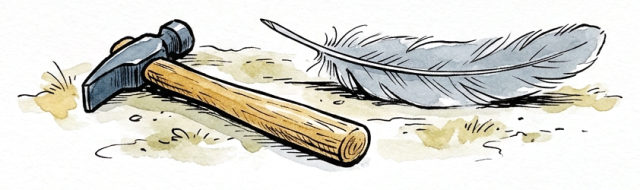
The cleanest check is somewhere with no air. On 2 August 1971, at the end of the last moonwalk of Apollo 15, Commander David Scott held up a geologic hammer and a falcon feather and let go of both, live on TV. On the Moon, where there is almost no air, they hit the ground together. "How about that!" he said.
So a child who agrees has seen something real: down here, a feather really does fall slower. The round's move is asking why.
Sources: NASA NSSDC, "Apollo 15 Hammer-Feather Drop" (nssdc.gsfc.nasa.gov/planetary/lunar/apollo_15_feather_drop.html); the Apollo 15 Preliminary Science Report, NASA SP-289 (Joe Allen); Scott's words are from the mission transcript in the Apollo Lunar Surface Journal. You may hear that Galileo dropped balls from the Leaning Tower of Pisa. Historians doubt he did, so the round leaves it out. Galileo did work out that things fall together.
What kids usually bring
- "I've seen a feather fall slowly." True, and the round says so. The question is whether it's the weight or the air.
- "Heavy things get pulled down harder." A clever one, and the pull really is bigger. But a heavy thing also takes more pulling to get moving, so the two even out. The round only asks: then why did the hammer and feather land together?
- "Everyone knows a rock beats a feather." Kea says it too. It's a saying, and the astronaut checked it.
- "It's the air, not how heavy it is." The heart of it, in a child's words.
The round also asks your child to try it for real, with a shoe and a rolled-up sock. Whatever they report is welcome. A shoe can land a fraction first, or both can land too fast to see. Trying it is the point.
At dinner
Try the kitchen-table drop test together:
- With a grown-up nearby, stand on the floor (not on a chair). Hold a book flat in one hand and a flat sheet of paper in the other, both at shoulder height.
- Let go at the same moment, over a floor with nothing breakable nearby. The paper floats behind.
- Now scrunch the paper into a tight ball and drop it with the book again. They land together, or very nearly.
- Then lay the flat sheet on top of the book and drop them. The paper rides down with the book: the book keeps the air off it.
Ask: "The paper weighed the same both times. So what changed?"
Then the one rule: say their reason back before you give yours.
The round never tells your child what to think. This card tells you what we know, so you're never caught out. If your child wants to argue with it, that is the point.