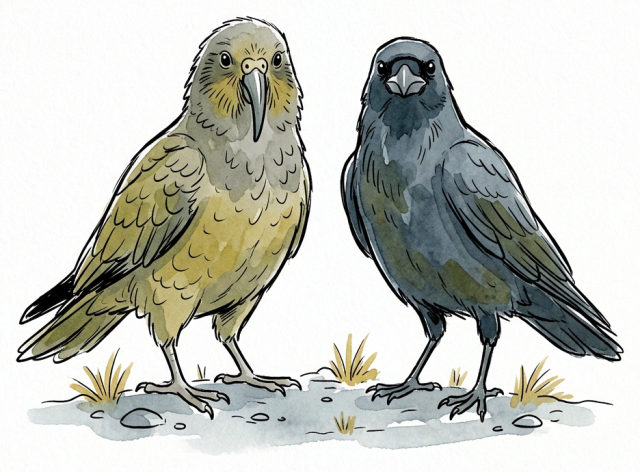
Kea are the cleverest birds.
for grown-ups
What we actually know
It depends what you mean by clever. Kea are very good at some kinds of clever. In a 2020 study, six kea at Willowbank Wildlife Reserve, in Christchurch, learned that black tokens meant food and orange ones didn't. Shown two jars of mixed tokens, with a hidden token taken from each, they mostly picked the hand from the jar more likely to give black: they used the mix to guess the likelier treat. Before this, only humans and great apes had been shown to do it. Other birds are clever at other things. New Caledonian crows make hooked tools from twigs and leaves to pull food out of holes, and are the only animals besides people known to make hooked tools in the wild. Kākā have been tested too: wild kākā at Zealandia, in Wellington, were given puzzle tasks (pull out a block, flip a lid, pull a string), and the young ones did best. Nobody has tested every bird at everything, so "cleverest" has no single answer.
The round's real subject is the source. Kea is making a claim about kea, and the Kākā about kākā. Wanting a thing to be true doesn't make someone wrong, but you'd want someone else to check.
Sources: Bastos and Taylor, "Kea show three signatures of domain-general statistical inference", Nature Communications, 2020 (University of Auckland news, 4 March 2020: https://www.auckland.ac.nz/en/news/2020/03/04/smarter-than-we-thought--kea-reason-about-probability.html). A June 2020 addendum re-checked the method with an extra control, and the authors say the results stand (https://pmc.ncbi.nlm.nih.gov/articles/PMC7272443/). Hunt, "Manufacture and use of hook-tools by New Caledonian crows", Nature, 1996; St Clair and colleagues, Nature Ecology & Evolution, 2018 (doi:10.1038/s41559-017-0429-7), on hooked tools in the wild. Loepelt, Shaw and Burns, Proceedings of the Royal Society B, 2016 (doi:10.1098/rspb.2015.3056), on kākā puzzles.
What kids usually bring
- "Kea get into bags and bins." A real observation: kea are famous for raiding packs and huts. In the round, Kea calls it a kind of puzzle, then notes that the record tested chances instead.
- "Kea said so." The best one for this round: the source is the one with the stake. Rock says it back ("Kea told you. I will remember who told you.") and later notes that the scientists told us too, but they checked, and they aren't kea.
- "Parrots can talk." Some parrots copy words. That's one kind of clever; the jar test checked another.
- "Crows use tools." True, and it's in the round's record.
- "Owls are wise." A saying from stories. Nobody in the round's record tested owls.
At dinner
Ask: "Who would be a fair judge of the cleverest animal? And clever at what?"
Then the one rule: say their reason back before you give yours.
The round never tells your child what to think. This card tells you what we know, so you're never caught out. If your child wants to argue with it, that is the point.