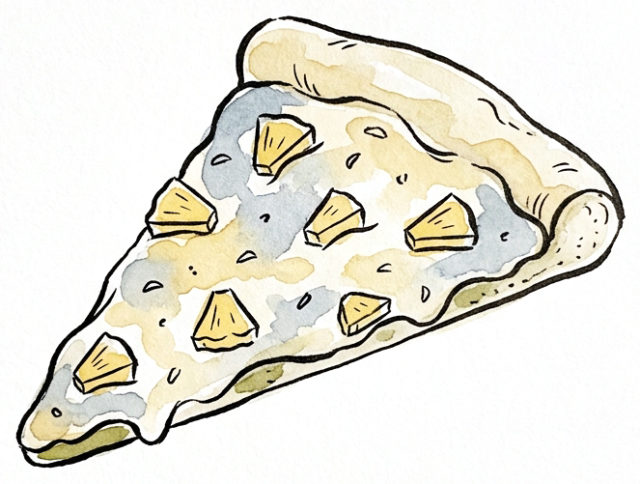
Pineapple belongs on pizza.
for grown-ups
What's actually true
Nothing, and that's the lesson. This is a taste: everyone is right about their own mouth, and nobody has to move. The round teaches the difference between a claim you can check and one you can't, and lets your child practise the hardest move: making the best case for a taste they don't share.
One fact turns up, as a surprise that changes nobody's taste: pineapple pizza (the "Hawaiian") is widely credited to Sam Panopoulos, a cook in Chatham, Ontario, in 1962. Some dispute it, which is why Rock says "the record says". It isn't a traditional Italian topping.
What kids usually bring
- "Sweet and salty together is delicious." A taste. Kea agrees.
- "It's not traditional. They don't do it in Italy." True, and interesting: it's a reason about history, not about how it tastes. The round asks whether where a food comes from changes its taste.
- "Fruit is for pudding." A rule about food. That's the Snail's reason, said from the look of it, since the Snail has never tried it.
- Having never tried it. Lots of children have a strong view on a food they've never tasted. The round notices, gently.
At dinner
Ask: "What food do you love that someone here doesn't? What's their best reason?"
Then the one rule: say their reason back before you give yours.
The round never tells your child the answer. This card does, so you're never caught out. If your child wants to argue with it, that is the point.