Kea & Rock and the Missing Glacier
for grown-ups · Rock's Origin · Expedition One
The big idea
Rock, the crew's ancient witness, has never known how it got here: it doesn't match the mountain it sits under, there is no ice in the valley, and its own memory stops at "cold; a long dark; then this valley." This episode reads the place like a detective. Every theory says what it would leave behind; the crew looks; and a chip of stone settles it. The ice was here. It's gone. It carried Rock. Rock learns the word for what it is: an erratic — "it means I wandered."
What happens (spoilers)
Kea walks circles around Rock with the Wonder Log and puts the question, and, this being the crew, asks Rock where its own "the ice brought me" comes from. Rock, honestly: "Cold. Then dark. I called it ice. I guessed." Rock's record is the smallest it has ever given: cold, a long dark, this valley. Kea's theory: Rock rolled down from the peak. Your child claims (rolled / ice / fell from the sky / not sure), tags, sets the meter, and may ask Rock what it remembers — Rock only reports what it saw, which is honest and not enough.
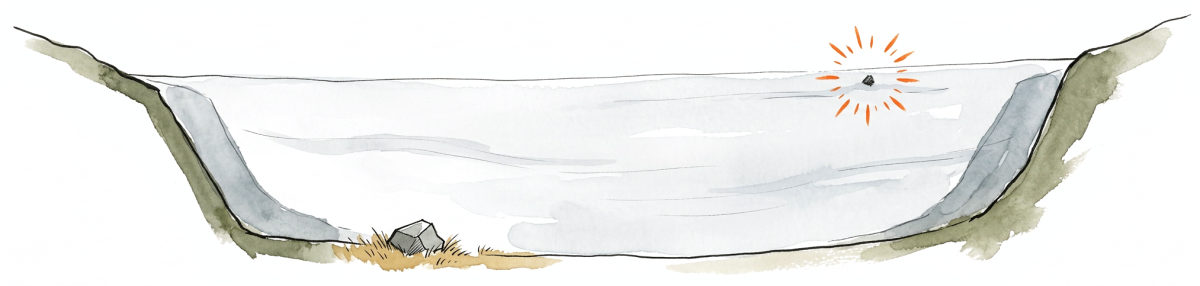
Next morning Kea draws three columns in the dirt: what would rolling leave (a scar down the peak, a rounded rock, peak stone)? falling (a hole, burnt ground)? ice (scratches from dragging, a heap of dropped stones, a trough-shaped valley)? The crew locks a prediction about Rock's back, then looks: long straight scratches, all one way ("I thought those were mine"); no burn; corners, not rounding. The heap is there. The valley is a trough. On the high route the scratches give a direction: up-valley. Then the sharpest check: a chip of Rock beside a chip of the peak. Brown, dull, crumbly against grey, hard, sparkly. Rock is not peak stone; Rock is far-range stone, and the far range is up the valley. Kea's rescue ("you rolled from the far range then!") meets Rock's flattest line: "Rocks do not roll uphill." The child names it: a rescue, like the sock, like the borrowed beak.
The realisation: the ice was here. It's gone. It carried you. Rock: "I remember cold." Kea: "You were inside it. The long dark was the ice."
The lichen on Rock's shoulder speaks (slowly): it arrived after Rock stopped, it grows a fingernail in a lifetime, and it is wider than Kea's wing. So the ice left long ago. The walkers who pass have a word for a stone the ice carried far: erratic. It means wandered. Rock, for once, ends with a question of its own: where in the far range did the ice pick it up? "That is another expedition."
The thinking your child practiced
- Predict the traces, then look. Each theory commits to what it would leave before anyone checks.
- Matching materials as a test. A theory can be killed by a grain of rock: Rock is not made of what the peak is made of.
- One story, no rescue. Four traces (scratches, heap, trough, stone) and one theory that needs nothing extra, against one that needs a rock to roll uphill.
- The witness's limits. Rock reports only what it saw, and says so; that is a virtue, not a gap.
- Slow time (light): a lichen is a clock you can read, roughly.
Words your child may come home saying
| Word | What it means |
|---|---|
| erratic | a boulder carried far from where it formed by ice that has since melted — Rock's word for itself: "I wandered" |
| the scratches / the heap / the trough | what a glacier leaves: striations on the rock it dragged, a moraine of jumbled stones, a U-shaped valley |
| a chip of stone | the material test: does Rock's rock match the peak's? |
| a fingernail a lifetime | how fast the lichen grows — a slow clock |
The home experiment
Freeze a pebble inside an ice cube. Put the cube at the top of a tray, tip the tray a little, and leave it in the sun. When you come back the ice has slid, melted, and dropped the pebble where it stopped, not where it started, with a wet trail between. Look where the pebble is and where the cube began; write both down. That is Rock, small.
Talk about it afterwards
- "Rock said 'I do not know' about its own arrival. Was that a weak answer or a strong one?"
- "Which single check would you have done first, and why?"
- "Kea's rolling theory needed a rock that rolls uphill. What did the ice theory need?"
For teachers
Planet Earth and Beyond: glaciation, erratics, moraines, U-shaped valleys, striations; Nature of Science: inference from multiple lines of evidence, testing by material comparison. Lichenometry (the high route's "measure, know the speed, divide") is a real, if rough, dating method.
Every expedition ends the same way for a grown-up: a home experiment, and something to talk about. Nothing here is homework. If your child wants to argue with the card, that is the point.