Kea & Rock and the Slow Clock
for grown-ups · Rock's Origin · Expedition Two
The big idea
Last time the crew worked out what carried Rock: ice, long gone. This time Kea wants a number for how long ago, and arrives with one: "one thousand years, exactly," from counting the bumps on the lichen and deciding a bump is a year. The episode is about clocks: anything that changes at a steady speed can tell you how much time has passed, if you know its speed, and you only know its speed by checking it against something whose age you already have. Every such clock gives a range ("at least forty lifetimes"), and a rough true number beats an exact made-up one.
What happens (spoilers)
Kea's number falls at Rock's first question: how do you know a bump is a year? ("It felt right.") Your child claims (a thousand exactly / nobody can know / Rock knows, ask Rock / not sure), tags a where-from, locks the Sure-o-Meter. Rock, the witness, is asked and answers honestly: it was in the ice and did not count; it cannot tell a hundred years from a thousand. A witness is not a clock. The lichen on Rock's shoulder says it does know its speed, a fingernail in a walker's lifetime, because it watched itself, and invites the crew to check.
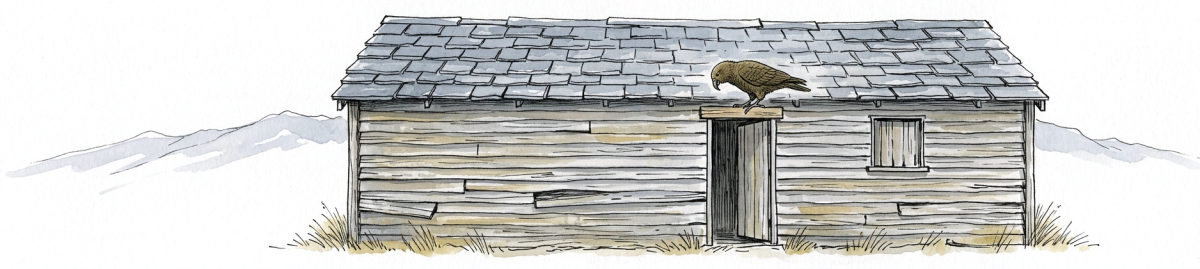
The check is a walkers' hut down the valley with its year carved on the beam: about a hundred and sixty years, two lifetimes. Predict before looking: at Kea's speed the lichen on the roof stones would be head-sized; at the lichen's own, a couple of fingernails. It's a fingernail and a bit. Kea's rescue ("baby lichens are shy!") gets named. Then the crew measures Rock's lichen in fingernails, forty and a bit, so at least forty lifetimes. Kea's thousand years is about twelve lifetimes: too small. The lichen adds the honest shape: at least, because it was not the first thing to grow on Rock.
The second clock is a fallen tree on the heap of stones the ice left. Its rings, counted exactly, say three hundred and twelve years, about four lifetimes: exact for the tree, only a floor for the ice, because the tree started late. Two clocks, different speeds, same direction; the biggest "at least" wins. Wing-Flash: anything that changes at a speed you know is a clock, and the past has a number on it, with honest fuzz around it. The high route adds the fuzz (say both edges: at least forty, probably more, not twelve, not a million) and why a hut (why a carved year is trusted: they were there, they count, and anyone can read the beam). Then the update, the meter reckoned against the first lock, the Log Entry, and Rock, who cannot count, liking the number: "Rough. Honest. It is more than I had."
The thinking your child practiced
- A clock needs a known speed. Kea's error is the whole lesson: an exact number built on a speed nobody checked.
- Checking a speed against something of known age (the dated hut). Real scientists do exactly this with lichens on gravestones and old walls.
- Predict, then look. The child locks the roof prediction before Kea climbs.
- Naming a rescue ("baby lichens are shy"): the fourth in the series, and the crew now hears them as they come out.
- "At least" is an answer. A clock that started late gives a minimum; two minimums agree; the bigger wins.
- Exact is not the same as complete. 312 rings is exactly the tree's life and only a floor for the ice.
- Units and conversion. Lifetimes and years, back and forth: a thousand years is twelve-and-a-bit lifetimes; 312 years is about four.
Words your child may come home saying
| Word | What it means |
|---|---|
| a clock | anything that changes at a steady speed you know: a lichen, a tree, an ice cube |
| a fingernail a lifetime | the lichen's speed, about a centimetre in eighty years |
| at least | the honest answer a late-starting clock gives: a minimum |
| the fuzz (high route) | the honest width of a rough number, said with both edges |
| a rescue | a patch added to a theory so it survives a bad result ("baby lichens are shy") |
| a walker's lifetime | the crew's unit of long time, about eighty years |
About the numbers, honestly
Lichenometry (dating a surface from the size of the lichens on it, calibrated on gravestones and huts of known age) and dendrochronology (tree rings) are real methods, and both give minimum ages for when a surface was uncovered. New Zealand's valley glaciers retreated roughly fourteen to eighteen thousand years ago; lichens don't live that long, and the tree started later still, so the crew's "at least forty lifetimes" (about three thousand years) is honest and deliberately far below the true figure. If your child asks how scientists get closer, the answer is more clocks: layers of lake mud, the slow decay of certain atoms in the rock's surface. All the same idea, at different speeds.
The home experiment
Make a clock, then read one. Put a cress seed on wet paper and, every day, mark its height on a strip of card: that's its speed. Then find a cress plant somebody else started and, from its height and your speed, say how many days old it is, as an "at least" (it may have grown slower in the shade). Ask them. Were you close? For one afternoon: an ice cube on a plate, marking the puddle's edge every ten minutes; then a "stranger" cube someone else put out, and a guess at how long it's been there.
Talk about it afterwards
- "Kea's thousand years was exact. Why wasn't it any good?"
- "The lichen said 'at least forty'. Is that knowing something, or not knowing?"
- "What else at home changes at a steady speed? Could you use it as a clock?"
For teachers
Nature of Science: measurement, estimation, and uncertainty; calibration against a known reference; minimum ages from proxies. Number: unit conversion (years ↔ lifetimes), division as "how many eighties in a thousand". Planet Earth and Beyond: glacial retreat, moraines (the heap), colonisation of bare surfaces. Lichenometry and tree-ring dating are both real, teachable methods; the episode's numbers are invented but the reasoning is faithful.
Every expedition ends the same way for a grown-up: a home experiment, and something to talk about. Nothing here is homework. If your child wants to argue with the card, that is the point.