Same Stars
for grown-ups: how did you see them?
What it teaches
Same Stars is about how you know an amount. Stars flash in the sky for half a second. Your child says how many, and then the question that matters: how did you see them?
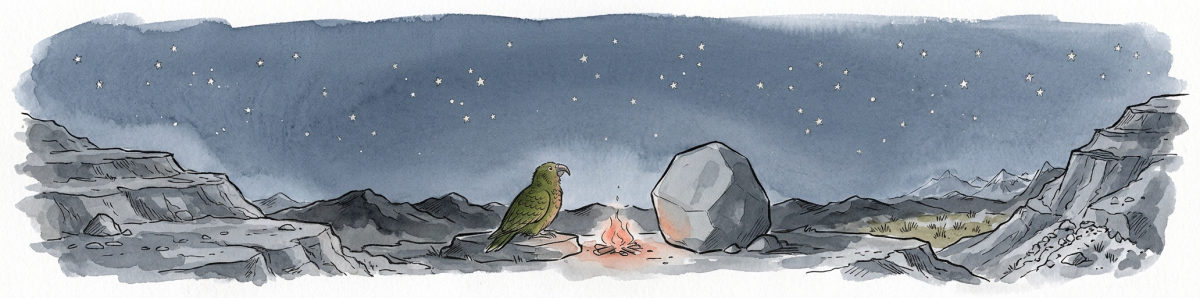
Maybe they just knew. Maybe they saw two rows of three, or a five and a bit more. Maybe they counted. Then Kea and Rock show how they saw the same stars, as rings on the sky. The rings are different; the total is the same. Same stars.
How a round goes
Three flashes on one sky, each a little harder.
- The flash. Half a second of stars. Then "Got it", or "Look again, longer" (one second, then two). Asking for a longer look is honoured, never a cost.
- How many? One tap on a row of numbers, 1 to 20, the same in every round so it never hints. "I'm not sure" is on the row too.
- How did you see them? The stars come back and stay. Your child builds their way from dot groups (a 3, a 3, a 1), and each group rings matching stars on the sky. Or they pick "I just knew", "I counted", or "I saw it another way".
- The others. Kea's way, then Rock's, sometimes the Duck's, each ringed over the same stars with one line. Then: "Can you see it Rock's way?"
- The check. "Count them now, if you like." The stars light up one by one.
At the end: which way of seeing was the most use? And one thing to try off the screen.
Why "how did you see them?"
Saying how you know something is the habit every place at camp practises. Here it's in its smallest form: a glance. Did you count, or did you see it?
And seeing groups is where number sense starts. A child who sees eight stars as "four and four" is adding without being asked to. Over a few rounds, the groups they built afterwards start to show up in the glance itself.
What the research says
We try to be straight about this.
- Well researched: seeing up to about four things at a glance, without counting, is called perceptual subitising, and it has been studied since the 1940s. Seeing bigger amounts as groups of small ones ("five and three") is conceptual subitising (Clements, 1999). Both are linked to early number sense.
- Widely used, fewer controlled studies: the classroom routine this round comes from, flashing a dot picture and asking "how did you see it?" (dot-card number talks, quick images). Teachers report it works; the evidence for it as a routine is thinner than for subitising itself.
- What we don't claim: faster maths, or anything about screen time. The claim is modest. It's practice at noticing how you know an amount, and at hearing that someone else saw it differently.
What gets celebrated
Not the right number. A near miss after half a second is what eyes do, and the check settles it without a verdict. The patches are for moves:
- Said "I'm Not Sure": asked for a longer look, or said "I'm not sure" on the number row.
- Changed My Mind: building the groups showed a different number, and they went with it.
- Saw It Their Way: could see the stars Rock's way.
- Checked It Myself: counted them at the check.
Every way of seeing counts, counting included. The round just shows there are others.
Try it at home
Anything you can show quickly works: fingers, coins, dots on a dice, biscuits on a plate.
- Show it for a moment, then hide it. Ask: "How many?"
- Then the real question: "How did you see them?"
- Say how you saw them. Was it different?
- Show it again and count together.
Children are delighted when a grown-up's way turns out to be the slow one.
What it will never do
No ads, no accounts, no leaderboards, no points to chase. Nothing times your child's answer. The rounds keep no scores, no answers, and not even a save, only a stamp on the shelf for each round played, kept on your device.
The rounds
- First stars
play for grown-ups - Southern lights
play for grown-ups - Moon night
play for grown-ups - Dusk
play for grown-ups
Questions, corrections, ideas