Kea & Rock and the Leaning World
for grown-ups · Seasons · Expedition Two
The big idea
Episode 1 established WHAT winter does (shorter days, lower sun — checked against records, a book, and a well-travelled whale). This episode asks WHY, and teaches the tool for questions you can't reach directly: build a model. Nobody can fly above the world, but anyone can walk a leaning pebble around a campfire and watch seasons happen.
What happens (spoilers, since you're a grown-up)
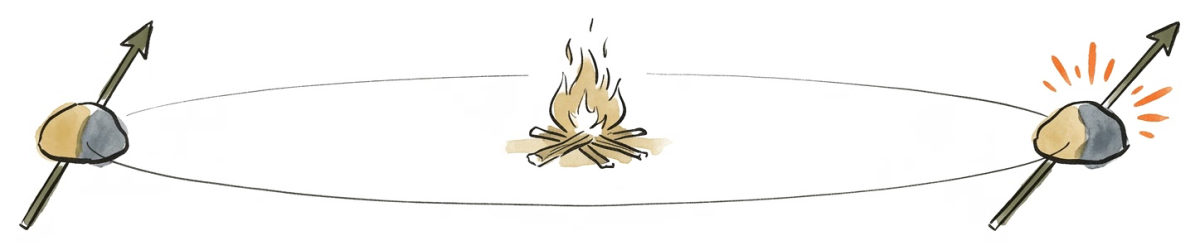
Kea's new theory is that the world leans toward the sun in summer (it likes the warmth) and away in winter — tipping back and forth. Your child makes their own claim, then the crew builds a model: the campfire is the sun, a pebble on a stick is the world (Rock declines the role), and the pebble's lean points at a distant peak and is never touched. The model gets a whole evening before it moves: standing still, one lean already makes two different lights (one half soaked, one half squinting). Then, the next night, the walk: circling the fire, the two halves swap seasons all by themselves — opposite halves, exactly what the whale reported — and the quarter-way stops turn out to be autumn and spring, which nobody even asked the model to produce. Kea tries to rescue the tipping theory ("maybe the world re-leans when nobody is watching") and catches the pattern mid-sentence: this is the "wind that borrowed a beak" all over again — a theory that needs a rememberer.
The realisation: the lean never changes; the trip changes everything.
The final scene runs the checklist: one theory has to explain all four things the crew ever checked — lower sun, shorter days, the whale's warm north, and the Norway book (written on the other half of the world). The script plants a genuine misremembering: Kea misquotes the whale (and briefly pretends it was a test, which Rock does not allow). A child who catches it earns a patch, and a child who doesn't gets the quiet lesson that this is exactly why crews write things down.
The thinking your child practiced
- Testing the unreachable with a model — and, just as important, interrogating the model itself: "can a model be wrong?" is a celebrated question, not an insolent one.
- Spotting theories that need rescuing. A theory that only survives by adding helpers ("the world re-leans when nobody watches") is usually on its way to the compost. Kids meet this as a pattern they have seen before, not a rule handed down.
- One theory, many checks — a good explanation has to fit all the evidence at once, not just the piece in front of you.
- The written record beats memory — Kea's misquote of the whale is caught by the Wonder Log, not by anyone's recall.
- Confidence that tracks evidence — the Sure-o-Meter is re-read against how things turned out, and the needle is allowed to climb after four checks.
Words your child may come home saying
| Word | What it means |
|---|---|
| model | a small version of a big thing, keeping only what matters, so you can test an idea you can't reach |
| the lean and the trip | the world leans one way, always; travelling around the sun is what changes the seasons |
| one theory, four checks | the crew's test for a good explanation: it has to fit everything |
| compost | where wrong theories go — they aren't failures, they grow better ones |
(Plus the standing kit: crew, where-froms, Sure-o-Meter, Wonder Log, Wing-Flash, patches.)
The home experiment
Rebuild the model in your lounge: a lamp for the sun, an orange (or a potato) on a skewer for the world. Tilt the skewer, pick a doorknob or window for the lean to point at, and walk a slow circle around the lamp without touching the tilt. Ask which half is having summer at each stop. Two minutes, no equipment you don't own, and it earns the Checked It Myself patch all over again.
Talk about it afterwards
- "Kea said the whale reported COLD up north. What saved us — someone's memory, or the Wonder Log?"
- "The tipping-world theory needed the world to remember to tip. Why was that a warning sign?" (They met the same pattern in the First Expedition: the wind that borrowed a beak.)
- "The pebble isn't really the world. So why did walking it around the fire count as checking?"
For teachers
The model scene is a ready-made classroom demo (globe, lamp, one volunteer to walk). The high route (roughly ages 9–10) adds the torch-beam beat — slanted light is the same light spread over more ground, which is why a low sun is a weak sun — and the counterfactual "what if the lean were bigger?", both of which run well as short discussions. The planted misquote is a nice five-minute exercise on primary sources: what did the witness actually say, and where is it written down?
Curious Kea · a story about how we know things · curiouskea.nz
Every expedition ends the same way for a grown-up: a home experiment, and something to talk about. Nothing here is homework. If your child wants to argue with the card, that is the point.