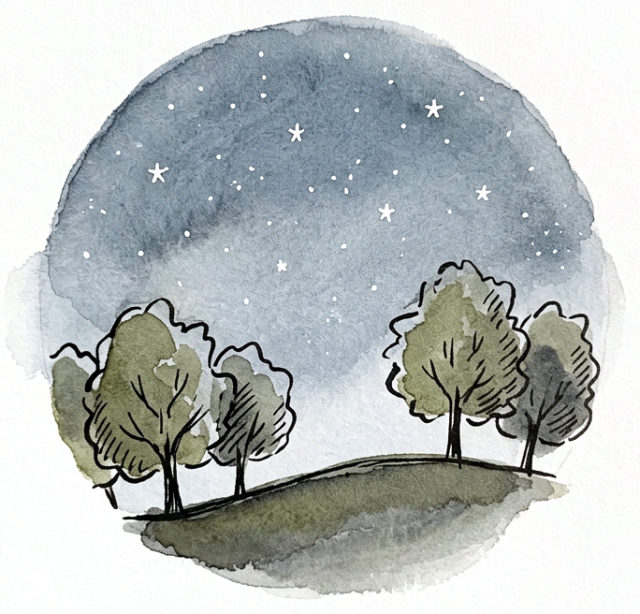
There are more stars in our galaxy than trees on Earth.
for grown-ups
What's actually true
Trees win, by a lot.
- Trees: about three trillion on Earth. Researchers counted the trees in about 430,000 small plots around the world, then used satellite maps to work out the rest (Crowther and colleagues, Nature, 2015).
- Stars: our galaxy, the Milky Way, holds an estimated 100 to 400 billion. Astronomers count the stars near us and scale up using the galaxy's light and mass (the European Space Agency's estimate).
Even the highest star estimate is less than a seventh of the tree count.
The catch your child may spot: in the whole universe we can see, stars win by far. The claim says our galaxy, and reading a claim carefully is part of the round.
What kids usually bring
- "The sky is full of stars." An honest observation of a small part: on a dark night, eyes see a few thousand stars.
- "Space goes on forever." The best one: it answers a different question (all of space, not our galaxy). Kea makes the same mistake and owns it: "I read it too fast."
- "The galaxy is way bigger than Earth." True, but bigger isn't the same as more. Kea asks which has more ants: a paddock, or an ant nest?
- "Nobody can count either of them." Half true. Nobody counted them all, but both were worked out. The round ends on checking how the counters counted.
At dinner
Ask: "How could you count the trees in our street without counting every one?" Then try it: count one patch, and work out the rest.
Then the one rule: say their reason back before you give yours.
The round never tells your child the answer. This card does, so you're never caught out. If your child wants to argue with it, that is the point.