Moa were real birds, taller than a grown-up.
for grown-ups
What we actually know
Yes, for the big ones. Moa were real birds that lived only in New Zealand: nine species, none of which could fly. The biggest, the South Island giant moa, stood up to about 2 metres high at the back (about the height of a door) and could weigh around 250 kg. Not every moa was big: the little bush moa, the smallest and most widespread, was about the size of a turkey. So the claim is true of the giants, not of every moa.
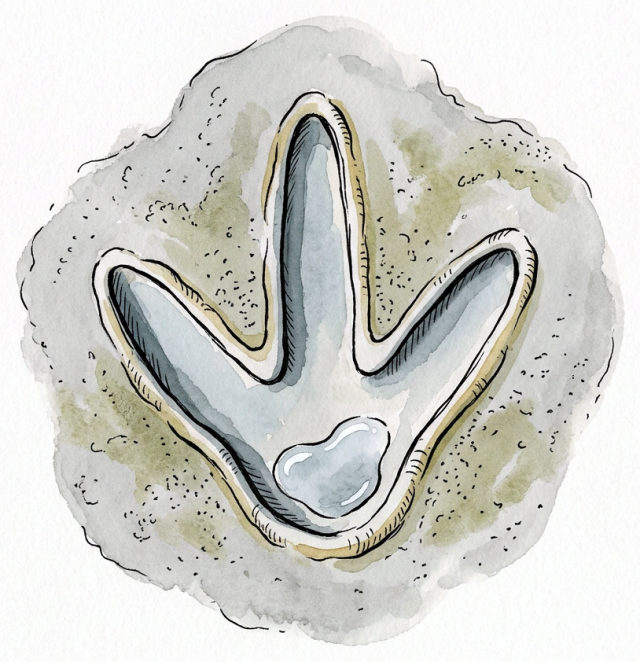
Nobody alive today has seen a moa. They died out soon after people arrived in Aotearoa, mainly from hunting, along with the burning of their forests. The last ones died about 600 years ago. What we know comes from what they left behind: bones from caves, swamps and sand dunes, eggs, feathers, and footprints pressed into old riverbed mud. In the summer of 1935, gales shifted big sand dunes at Doubtless Bay in Northland and uncovered the bones of several kinds of moa. That's the Wind's story in the round.
The round's real subject is witnesses that aren't people. Kea's reason is true (nobody alive has seen one), but it doesn't settle the claim. Things nobody alive saw can still leave a record behind.
Sources: Te Papa, Colin Miskelly, "Extinct birds of New Zealand – Moa" (blog.tepapa.govt.nz, 2015); New Zealand Birds Online, "South Island giant moa" (M.J. Szabo) and "Little bush moa" (nzbirdsonline.org.nz); Perry and colleagues, Quaternary Science Reviews, 2014 (the timing of the extinction, from 653 radiocarbon dates); Tomlinson, Fordham and colleagues, Science of the Total Environment, 2025 (hunting of moa and their eggs); Te Papa's 700-year-old moa egg, one of about 36 mostly whole (Council of Australasian Museum Directors); Papers Past, the moa remains uncovered at Doubtless Bay (December 1935); the moa footprints found near Ranfurly, Otago, in 2019 (Otago Museum, reported by CBC). You may read that the giant moa stood 3.6 metres tall. That figure is a length or a neck-stretched height, and how moa held their necks is debated, so the round uses the 2-metre back height only.
What kids usually bring
- "I've seen moa bones in a museum." Seeing it yourself, and the best kind of where-from here: those bones are the record.
- "Someone told me moa were giant birds." Being told is a fine where-from. The round asks whether the record says the same.
- "Ostriches are taller than people." A good piece of working out. A big male ostrich can stand about 2.75 metres (Britannica), though most are nearer 2 metres (Natural History Museum, London). If a bird alive today is that tall, a tall bird isn't just a story.
- "Nobody alive today has seen one." True, and Kea's reason too. The round asks what else could tell us, if no person can.
- "Birds aren't that big." True of the birds we see today. The bones are bigger.
- "It sounds like a made-up monster." A fair first reaction. A made-up monster doesn't leave its bones in a museum.
At dinner
Ask: "How can we know about something nobody alive has ever seen?" If you're near a museum with a moa (Te Papa, Canterbury Museum, Otago Museum, Auckland Museum and many smaller ones have them), go and stand next to one together. Who's taller? Look at its back, not just its head.
Then the one rule: say their reason back before you give yours.
The round never tells your child what to think. This card tells you what we know, so you're never caught out. If your child wants to argue with it, that is the point.