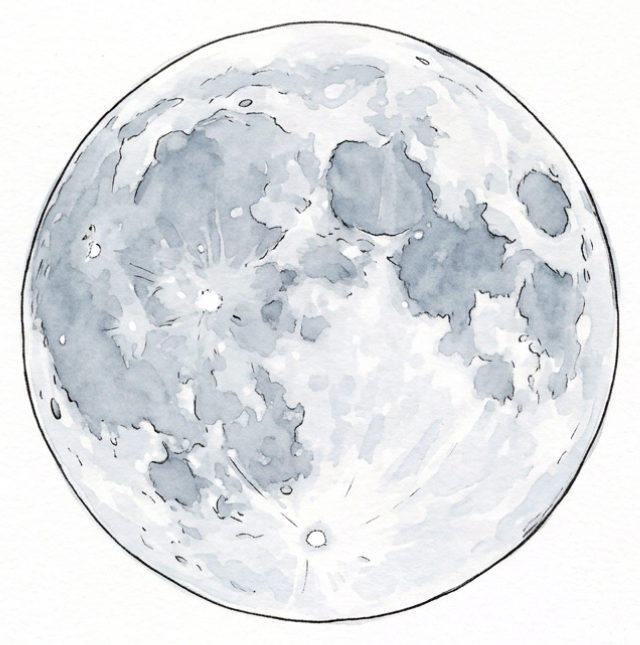
You can see the moon in the daytime.
for grown-ups
What we actually know
Yes, on many days. The moon doesn't make its own light: we see it because sunlight bounces off it, and that works in the day as well as at night. NASA puts it simply: the moon spends almost as much time in the daytime sky as in the night sky. In daylight it looks pale, so you have to look harder to spot it.
Some days you won't find it at all. Near the new moon, when it's too thin to see, it sits too close to the sun in the sky. Around the full moon it rises near sunset and sets near sunrise, so it's mostly a night sight then. And clouds can hide it on any day. So one look that finds nothing doesn't settle it.
The round's real subject is the word can. A child who disagrees has seen something real: the moon really is easiest to see at night. But "can" only needs one good sighting. (It's the mirror of the cats round, where "always" was the big promise.)
Sources: NASA, "Why Can You See the Moon During the Day? We Asked a NASA Scientist: Episode 19" (nasa.gov); BBC Sky at Night Magazine, "Why do we sometimes see the Moon during the day?" ("Near new Moon it is too close to the Sun to be seen"). You may read about first and last quarter moons as the best times. That's right, but the round leaves the names out and the card says "about a week before" and "about a week after" a full moon instead.
What kids usually bring
- "The moon comes out at night." True, and it's what most of us notice. The round asks whether night is the only time.
- "Day is for the sun. Night is for the moon." A tidy rule from stories and bedtime books, not from looking. Kea's view too.
- "I've looked in the day. It wasn't there." A real check, and the round counts it as one. Some days it really isn't there to see.
- "I've seen it in the day. It was pale." The best one: a child who has already looked.
- "The moon doesn't go away." Good reasoning: it doesn't switch off when the sun comes up.
The round asks your child to go and look, with you. Whatever they find is welcome. Finding it, not finding it, or "it's night here" are all fine; looking is the point.
At dinner
Go moon-spotting together this week:
- Never look at the sun, not even for a moment, and never through binoculars. Stand where a house or a tree hides it.
- About a week before a full moon, look in the late afternoon, towards the east: the moon rises before the sun sets.
- About a week after a full moon, look in the morning, towards the west: the moon is still setting after the sun has come up.
- A clear blue sky helps. Look for a pale white shape.
- If you can't find it, try the next day. It rises about 50 minutes later each day.
Ask: "You found it once. Does that show you can see it in the day? What if you'd looked and not found it?"
Then the one rule: say their reason back before you give yours.
The round never tells your child what to think. This card tells you what we know, so you're never caught out. If your child wants to argue with it, that is the point.