Kea & Rock and the Giant Chicken
for grown-ups · The Past · Expedition One
The big idea
How can you know something happened when nobody alive saw it? This episode's answer is the one children can use for the rest of their lives: the marks are the witness. A footprint, a bone, a heap of stones a bird once swallowed. It also carries a quiet second lesson, introduced in the First Expedition and named here: a theory that predicts nothing you could see either way can't be tested, so it can't be right or wrong. It goes in the drawer.
What happens (spoilers, since you're a grown-up)
Kea finds an old walking boot and, twenty hops on, a three-toed footprint bigger than Kea in hard old mud. Rock reads the boot first (red mud from the far valley, a heel worn on the outside: a leaning walker) to plant the idea that objects carry the marks of what happened to them. Then the theory: a giant chicken, still around, hiding. Your child makes their own claim, tags where it came from, sets the Sure-o-Meter.
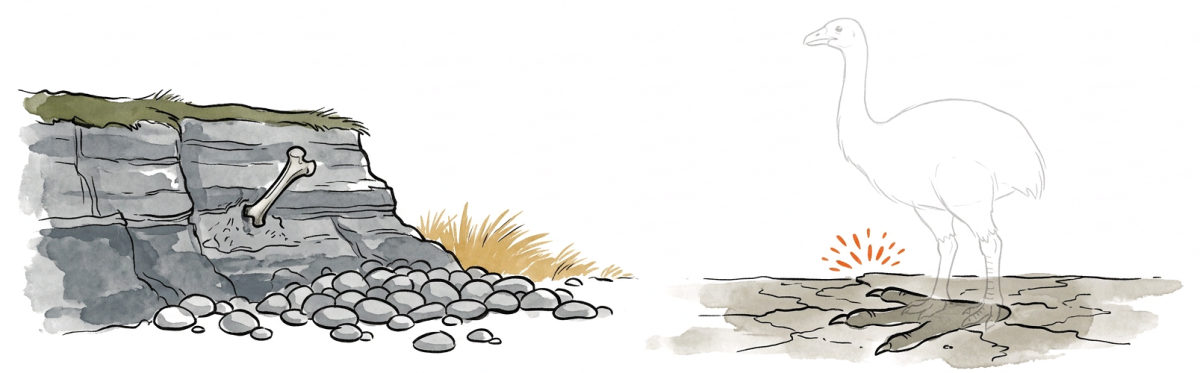
Next morning the crew predicts whether a chicken's small fourth toe will have left a mark at the back, before looking. Kea reads a crack as that toe; a child who spots it earns Caught a Mistake. Measured in Kea-lengths, the print belongs to a bird taller than Rock. Kea's rescue ("a giant chicken wearing a giant sock") is recognised on sight: the wind that borrowed a beak, again. Rock, who is very old, says plainly: big birds walked here; then no birds.
The bank behind the print has bones in it, and a heap of smooth stones Rock explains ("inside-a-bird stones"). Then the test of the hiding theory: if the bird is hiding, what would we see? Nothing. If it's gone? Nothing. The same nothing. Rock's verdict: a theory that can't be checked can't compost; Kea names where it goes instead: the drawer. Kea sharpens it into something checkable (a bird taller than Rock would still leave fresh prints, droppings, stripped bushes) and the crew looks: nothing fresh anywhere.
The realisation: the ground remembers what nobody alive saw.
In the last scene Rock tells what it saw. Tall, slow, unafraid birds that ate the bushes down to Rock height; then people came and hunted them; Rock saw nobody count them, so nobody knew they were running out; one year, no birds. Their name came later: moa. The high route adds the obvious question — how would anyone have known? Count them, every year. Then the Wonder Log, and a tease: the grey stone under the hill was hard before any bird walked here. Are there things even Rock never saw?
The thinking your child practiced
- Reading traces as evidence. A print, a bone, a heap of gizzard stones — each is a witness you can question, and they agree with each other and with Rock's memory.
- Predict, then look. The back-mark prediction is locked before Kea looks, and the "what would we see if it lived here now" list is locked before the crew looks around.
- The drawer. A claim that predicts nothing you could observe isn't wrong; it's untestable, and untestable claims can't move the meter. "A theory that can't lose can't win."
- Naming a rescue. The sock. Children who met the borrowed beak in the First Expedition and the tipping world in Seasons now spot the pattern unprompted.
- Testimony that agrees with traces is stronger than either alone.
Words your child may come home saying
| Word | What it means |
|---|---|
| the marks are the witness | you can know something was here from what it left behind |
| the drawer | where a theory goes when it can't be tested (not true, not false, not useful) |
| inside-a-bird stones | gizzard stones — smooth stones some birds swallow to grind food |
| deeper is older (high route) | in layered mud or rock, lower layers were laid down first |
(Plus the standing kit: crew, where-froms, Sure-o-Meter, Wonder Log, Wing-Flash, patches, compost.)
About the moa, honestly
The episode says plainly, without blame, that people hunted the moa and that nobody counted them. That is the accepted account: moa were hunted to extinction within a couple of centuries of people arriving in Aotearoa, roughly six hundred years ago. If your child asks more, the useful adult framing is the one Rock gives: nobody counted, so nobody knew until it was too late — which is why crews keep records. Moa also live in te ao Māori; te reo has a saying, ka ngaro i te ngaro a te moa ("lost as the moa is lost"). The episode doesn't use it; you might.
The home experiment
Have someone leave a footprint in sand, mud or a tray of flour while your child looks away. Then read it: which shoe? which foot? walking or running? And the good question at the end: what can't the print tell you?
Talk about it afterwards
- "Kea's hiding chicken couldn't be checked. Why isn't 'can't be checked' the same as 'wrong'?"
- "Rock saw the moa. The bones say the same thing. Why does the crew trust that more than either on its own?"
- "Nobody counted the moa. What would you count, if you wanted to know something was running out?"
For teachers
Curriculum touchpoints: Nature of Science (evidence, inference from traces); Living World (extinction, human impact); Planet Earth and Beyond (sedimentary layers on the high route). The episode models a testable vs untestable claim explicitly, which is a useful hook for a class discussion about what makes a question scientific.
Every expedition ends the same way for a grown-up: a home experiment, and something to talk about. Nothing here is homework. If your child wants to argue with the card, that is the point.