Kea & Rock and the Bones Nobody Saw
for grown-ups · The Past · Expedition Two
The big idea
Episode 1 was about traces of something a witness (Rock) had seen. This one removes the witness: the bones in the grey stone are older than Rock. So how does anyone know anything about the animals? The answer is a person, the Bone-Reader, and the point of her is that she is a source, not an authority: she tells you what she looked at, she can be wrong, and her whole trade once was, for a hundred years, until someone found feathers in the stone and they all changed the drawings. The realisation: being wrong and fixing it is not knowing nothing; it is how knowing is done — the crew's loop, at the scale of many people and many years.
What happens (spoilers)
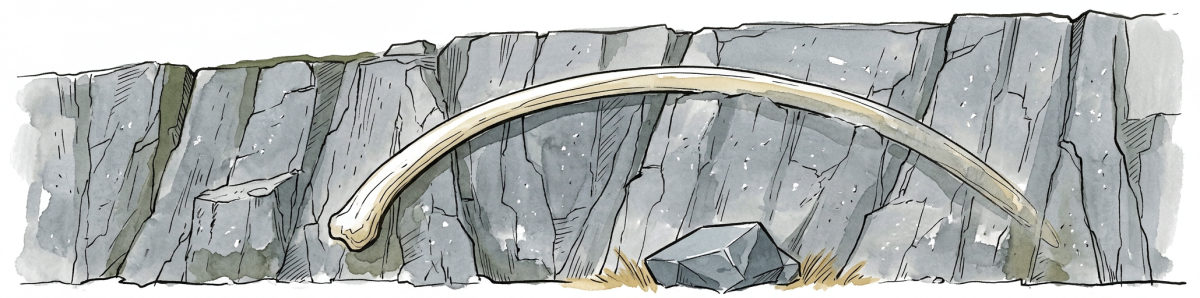
A rib longer than the moa's leg, set in stone Rock says was already old when the ice brought it. Kea: a dragon. Your child claims, tags, sets the meter. Rock has spotted a walker with a brush and a notebook camped down the valley.
The Bone-Reader arrives, kneels, and looks for a long time before she speaks. Where is Kea's dragon from? "Somebody told me." Hers: "I looked at three hundred bones." She lays out three bones and three drawings (tree-tall neck; big-legged runner with tiny arms; flat swimmer) and the child picks; then she makes the bones vote (small neck bone, a joint that bends one way, a runner's leg). Right or wrong, the child has done the job: say what the drawing predicts, look at the next bone. On the high route she offers the three questions to ask any expert: what did you look at, could you be wrong, what would change your mind. Questions follow (how old? do readers disagree? could it still be a dragon? — "bring me a wing bone").
Next day: a wrapped slab. Before she unwraps it, the crew locks a prediction: scales or feathers? Feathers, pressed in the stone around a small arm bone. A hundred years of drawings, changed. Kea leaps: "You were WRONG, so bone-readers know NOTHING, so my dragon is back." A child who catches the leap earns Caught a Mistake; if not, Rock does it, gently ("You have both been wrong this week. Do you know nothing?"). The Bone-Reader: we kept the bones, we kept the old drawings, new marks came, we looked and argued and looked again, we changed the drawing. Kea: that is the crew. A big slow crew. Rock: with records.
The last scene walks the chain: how did "dragon" get into Kea's head? Told, at a picnic; they'd read it; who wrote it, and had they looked? Three links Kea can't check, against the Bone-Reader's one, which the crew watched her check. Every link is a place to ask "how do you know". The dragon goes in the drawer until a wing bone turns up. Log Entry, and Rock's own question sets up the next pack: "You keep saying the ice brought you. There is no ice." "I know. I do not know how I got here."
The thinking your child practiced
- Expert knowledge as a where-from you can ask about. Not "she's a scientist" but "she looked at three hundred bones, and here is how she reads them."
- The same evidence, several drawings. The one that predicts the next bone wins; being wrong on the first pick is the normal case.
- A field changing its mind is checking, not ignorance. The planted leap ("wrong once, so know nothing") is exactly the leap adults make about science in the news; children practise catching it here.
- Chains of telling. Told/read/written/looked; count the links you can't check.
- Independent agreement (high route): many people who looked separately, same answer.
Words your child may come home saying
| Word | What it means |
|---|---|
| bone-reader | someone who works out animals from their bones — a person with sources, not an authority. The grown-up word is palaeontologist (fossils and long-gone animals); an archaeologist digs up the human past. Both read what was left behind. |
| make the bones vote | check each drawing against each bone in turn |
| the chain | told → read → written → looked: every link is a place to ask "how do you know" |
| a big slow crew | what a whole field of people checking each other over years amounts to |
| three questions (high route) | what did you look at · could you be wrong · what would change your mind |
The home experiment
After a chicken dinner, keep three bones. Two people each draw "the animal" from the bones alone, without conferring. Compare. What did each of you add that the bones never said? Then ask each other how you know — loudly, if you like.
Talk about it afterwards
- "The bone-readers were wrong about scales for a hundred years. Does that make you trust them more or less? Why?"
- "Kea's dragon came from a picnic. Which link in that chain would you go and check first?"
- "What are the three questions you'd ask anyone who says they know something?"
For teachers
Nature of Science: evidence and inference; how scientific knowledge changes; distinguishing sources by their basis. The feathered-dinosaur revision is a real and well-documented episode in the history of palaeontology and a good class example of provisional knowledge.
Every expedition ends the same way for a grown-up: a home experiment, and something to talk about. Nothing here is homework. If your child wants to argue with the card, that is the point.