Pebbles on Rock's table
for grown-ups
What's going on
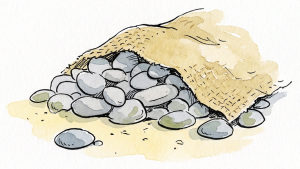
Your child gets a three-second look at 38 pebbles, then guesses a range: "somewhere between 25 and 70". Then they pick two clues to narrow it. Lifting a corner shows 9 pebbles in a quarter of the tray (so about 36). Lifting a strip shows 13 in a third (so about 39). The count is 38: both clues were close, and neither was exact.
That's the point of the round. A first guess is allowed to be rough; you start somewhere, then work at it. And "about" means about: a quarter of a tray is never quite a quarter, which is why a range beats a single number.
The maths: multiplying a small count (×4, ×3) to estimate a big one.
These are the numbers in the first play. Each replay uses a different tray, checked to teach the same thing.
What kids usually do
- Go very narrow first, like Kea ("Fifty. Exactly fifty."). Being sure feels good. The round doesn't punish it, but it lets them see Rock's wide range catch the answer.
- Try to count during the look. Three seconds is too short, on purpose. Estimating starts where counting stops.
- Skip the Compare clue ("the right side has a few more"). It gives no number, so it feels weak. It is weak, and that's worth noticing.
At dinner
Ask: "How many peas on your plate? Not a number. A range."
Then count them together. Did the range catch it? Would you make it wider or narrower next time?
The round celebrates how the range moved, not landing on the number. This card tells you what's in the tray, so you can play along.