Somewhere Between
for grown-ups: how many, and how sure?
What it teaches
Somewhere Between is about how sure you are, in numbers. Each round gives your child a three-second look at a tray of things (pebbles, seeds, feathers), too quick to count. Then it asks how many, as a range: "somewhere between 25 and 70".
Then come the clues. Your child picks two:
- Lift a patch of the cover, count what's under it, and do the sum. A quarter of the tray holds 9, so about 36.
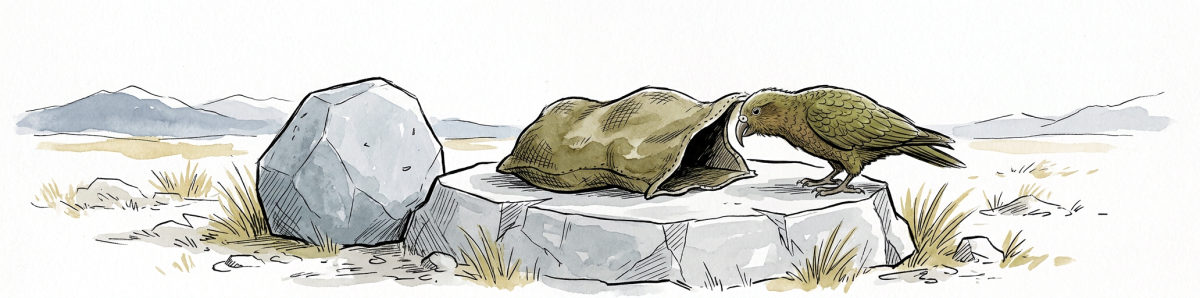
- Hear what someone noticed: "about 15 beakfuls, about 10 seeds each". So about 150.
- Hear a guess with nothing behind it: "Hundreds and hundreds!" and decide what it's worth.
After each clue they can move their pegs, in or out. Then the tray is counted, one at a time, in tens.
Why a range
A single number is either right or wrong, and from a quick look it's nearly always wrong. A range says how sure you are: wide means "not very sure", narrow means "sure". Your child watches their own range shrink as they find things out.
The first guess is allowed to be rough. You start somewhere, then work at it. That's the whole method.
The maths
Each clue invites a small calculation, done because it helps: four quarters, ten tenths, groups of ten. And "about" stays about. A quarter of a tray never holds exactly a quarter of the pebbles, which is why a range beats a single number.
What gets celebrated
Not landing on the number. The round says so when the count lands inside the range, but the patches are for moves:
- Narrowed It Down: pulled the range in after a clue, whether or not the count landed inside.
- Changed My Mind: a clue moved the range. Wider counts too.
- Said "I'm Not Sure": a first range that was honestly wide.
- Checked It Myself: counted a patch and did the sum.
Try it at home
Anything countable works: peas on a plate, cars in a car park, steps to the letterbox.
- Take a quick look. Ask: "How many? Say it as a range."
- Ask what would help narrow it. Count a part, then do the sum.
- Pull the range in.
- Count to check. Did it land inside? Is it narrower than the first?
Children are very good at catching a grown-up whose range was suspiciously narrow to begin with.
What it will never do
No ads, no accounts, no leaderboards, no points to chase. The rounds keep no scores, no answers, and not even a save, only a stamp on the shelf for each round played, kept on your device.
The rounds
- Pebbles on Rock's table
play for grown-ups - Kea's seed stash
play for grown-ups - Feathers in the snow
play for grown-ups
Questions, corrections, ideas